
Transforming leaders into
Master Story Tellers.
StoryBit Pro is an invite-only workspace for executives, coaches, and leadership teams.
StoryBit Pro is an invite-only workspace for executives, coaches, and leadership teams.
Full access to the 8-stage leadership framework. Cancel any time.
Invite-only early access preview · Payments are not yet enabled · Privacy · Terms · hello@storybitpro.com
StoryBit Pro guides you through 8 proven stages — from context to transformation. Tell the stories that define your leadership.
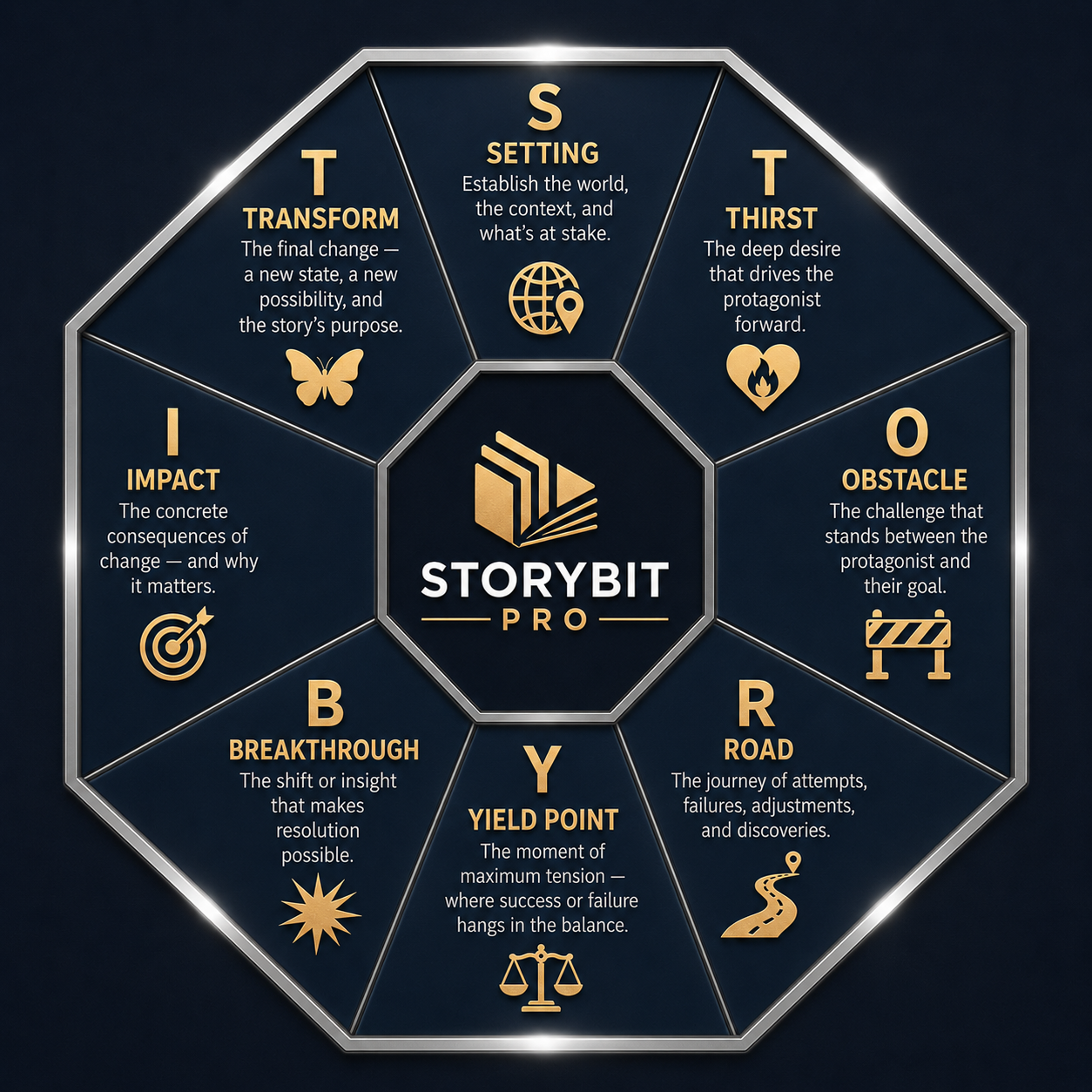
Click any compass segment to jump to a stage
Templates pre-fill each stage — edit freely to make it yours.
Review, polish, export, or share.
Your story text is sent to Anthropic’s Claude to create the polished version · Privacy
There is a technology more powerful than the printing press, more immediate than the internet, more personal than any algorithm ever devised. It predates every written language. It preceded every empire, every religion, every civilization. It is the technology by which human beings have always made meaning, passed wisdom, forged loyalty, and moved each other to action.
That technology is the story.
At StoryBit, we do not merely teach presentation skills or communication techniques. We teach the mastery of the highest form of human expression. We teach the art, the craft, and the discipline of storytelling — because we believe, without equivocation, that the person who commands the story commands the room, the negotiation, the boardroom, and the culture.
This primer is our declaration of philosophy. It is the foundation upon which everything we teach is built. It explains why storytelling is not a soft skill but a supreme skill. Why it works when facts alone fail. Why it endures when everything else fades. And why the leaders, communicators, and change-makers of our era — more than any era before — must master it.
Read it carefully. Return to it often. And when you finish, ask yourself: What story are you telling? And is it worthy of the listener?
Before there were cities, there were fires. Before there were books, there were voices. Before there were documents, reports, presentations, or data visualizations, there was one human being sitting across from another, leaning close, and saying: Let me tell you what happened.
The evidence is painted on cave walls. In the Lascaux caves of southern France, painted approximately 17,000 years ago, ancient humans depicted animals in motion — bison charging, horses running, aurochs turning. These were not mere decorations. They were the first attempts to capture and transmit experience: to freeze a moment in time and share it with those who were not there. They were stories. And they endured.
For all but the most recent fraction of human history, the spoken word was the only word. Writing, as we know it, is roughly 5,000 years old. The printing press is barely 600. The internet is a heartbeat. But the human voice telling a human story is as old as our species itself — at least 100,000 years by conservative anthropological estimate, and in all probability far older.
Every civilization that has ever existed was first built on story. The great epics — the Iliad, the Mahabharata, the Epic of Gilgamesh — were not written literature in their origins. They were spoken. They were memorized by poets and transmitted generation to generation in the living breath of performance. Homer's Iliad, scholars estimate, was composed and performed orally for centuries before anyone wrote it down. And yet it endures to this day.
This is the first truth of storytelling: it is ancient. It is primal. It is not a method invented by communications consultants. It is the mechanism by which the human mind has always organized reality, made sense of chaos, and transmitted what matters across the vast distances of time.
Long before ink and paper, communities were held together by the spoken covenant: the promise made aloud before witnesses, the oath sworn on sacred ground, the law recited in the village square. The spoken word carried weight because it was irreversible. Once spoken, it existed in the ears of others. It was witnessed. It was real.
In many of the world's great legal and religious traditions, the oral proclamation remains the binding act. A marriage is not consummated by a signed document alone — it is spoken. A court oath is not signed — it is sworn aloud. In Jewish tradition, the giving of the Torah at Sinai was, first and foremost, an act of divine speech. In Islam, the Quran — meaning "the recitation" — was spoken before it was written. The spoken word was not the precursor to the real thing. The spoken word was the real thing.
This ancient covenant between speaker and listener has not been broken by modernity. It has merely been forgotten by those who trust PowerPoint over presence, data over drama, and bullet points over the beating heart of a well-told tale. StoryBit exists to restore what has been forgotten — and to arm those who lead with the most powerful instrument they will ever possess.
The question is not why stories are important. The more illuminating question is why we cannot function without them. The answer runs deeper than culture. It runs into biology.
Human beings are unique among all known species in their capacity for what cognitive scientists call "mental time travel" — the ability to project themselves into imagined past and future scenarios. We do not merely respond to what is happening. We construct narratives about what happened, what is happening, and what might happen. We are, as psychologist Jerome Bruner argued, homo narrans: the storytelling animal.
The narrative mode of thought is not a luxury or an evolutionary accident. It is how the human mind learns to navigate an uncertain world. Stories are the cognitive containers in which experience becomes knowledge, and knowledge becomes wisdom. Strip away the story, and you are left with raw data — the equivalent of unprocessed sensory input, meaningful to no one.
Westenberg's claim is bold but defensible. Consider: every other technology extends or amplifies a human capability. The wheel extends locomotion. The telescope extends vision. The computer extends calculation. But storytelling does something more fundamental: it extends the self. Through story, a person can inhabit another life, absorb another's experience, feel another's grief or triumph as though it were their own. No other technology comes close.
When a person listens to a dry recitation of facts, only the language-processing areas of the brain activate — Broca's area and Wernicke's area, responsible for decoding words and syntax. The experience is transactional. Information goes in. That is all.
But when a person listens to a well-told story, something profoundly different happens. The brain responds as though the story were real experience. Describe a character running, and the motor cortex fires. Describe a scent, and the olfactory cortex activates. Describe texture, and the sensory cortex engages. A story does not merely communicate information — it creates an experience. The listener is transported.
Neuroscientist Uri Hasson at Princeton University demonstrated this phenomenon with extraordinary precision. When a speaker tells a compelling story, the brain patterns of the listener begin to synchronize with the brain patterns of the speaker — a phenomenon Hasson called "neural coupling." The better the storytelling, the more complete the coupling. The listener is not passively receiving a message. Their brain is literally aligning with the storyteller's brain. They are, in the deepest neurological sense, of one mind.
The neuroscientist Paul Zak has spent years studying the biochemical underpinnings of human trust and connection. His research yielded a remarkable finding: emotionally resonant stories trigger the release of oxytocin, sometimes called the "bonding hormone" or "empathy molecule."
Oxytocin is the neurochemical that drives maternal bonding, romantic attachment, and social cooperation. It is the chemical substrate of trust. Zak's experiments demonstrated that when subjects watched a narrative about a father and his terminally ill son, oxytocin levels spiked significantly — and those with the highest oxytocin spikes were also the most likely to donate money to charitable causes afterward.
The implications for leadership, persuasion, and communication are profound. A great story does not merely deliver information. It chemically predisposes the listener to trust the teller. It opens the door to empathy, generosity, and action. Data does not do this. Bullet points do not do this. Only story does this.
The scholar who came closest to articulating the biological universality of story was not a neuroscientist but a mythologist. Joseph Campbell spent his career studying the stories of human beings across every culture, every era, and every corner of the earth. What he found was astonishing.
Published in 1949, The Hero with a Thousand Faces presented Campbell's central thesis: that beneath the extraordinary diversity of human mythology lies a single, universal narrative structure, which he called the monomyth or the Hero's Journey. In cultures separated by oceans and millennia, in stories told by people who could not possibly have communicated with each other, the same story kept appearing: the hero is called to adventure, crosses a threshold into the unknown, faces trials, is transformed, and returns with a gift for their community.
The Hero with a Thousand Faces has been translated into over ninety languages. It has influenced not just scholars and students but the creators of some of the most powerful storytelling of the modern era — George Lucas credited Campbell explicitly in the creation of Star Wars. The Wachowskis drew on the monomyth for The Matrix. J.K. Rowling's Harry Potter follows its arc with uncanny precision.
Campbell's conclusion was unavoidable: human beings are not merely receptive to certain story structures. We are, in his phrase, hardwired to listen. The Hero's Journey is not a formula invented by clever screenwriters. It is the map of the human psyche — the pattern by which consciousness confronts challenge and emerges transformed. It works because it mirrors what it means to be alive.
In his PBS series with Bill Moyers, The Power of Myth, Campbell articulated why this matters beyond the academy: stories are the vehicles by which cultures transmit their values, their cosmologies, and their instructions for living. When a culture loses its stories, it loses its coherence. And when a leader loses the ability to tell a story, they lose the ability to lead.
Twenty-four centuries ago, Aristotle wrote Poetics — the first systematic analysis of storytelling as a craft. In it, he argued that narrative is the imitation of action (mimesis) and that the soul of drama is plot: the arrangement of events in a causally coherent sequence that produces, in the audience, the cathartic emotions of pity and fear.
Aristotle identified what every great storyteller has known since: that story is not the recounting of events but the causal logic between them. It is not that the king died and then the queen died. It is that the king died, and therefore the queen died of grief. The word "therefore" is the engine of story. Causality creates meaning. Causality creates stakes. And stakes create the emotional investment that no list of facts can manufacture.
He also gave us the three-act structure: beginning, middle, and end — and their functions. The beginning establishes the world and introduces disruption. The middle escalates through complication and reversal. The end resolves through transformation. This framework, refined over millennia by playwrights, novelists, screenwriters, and speakers, remains the foundational architecture of virtually every story told in the Western tradition. It is not a constraint. It is a map.
Few transformations in corporate storytelling are as instructive as Stephen Denning's. A senior executive at the World Bank, Denning found himself tasked with an apparently impossible challenge: convincing an institution devoted to data, analysis, and economic rigor that it needed to embrace a new concept called knowledge management. He brought reports. He built slide decks. He marshaled statistics. Nothing moved.
Then he told a story.
In his landmark work, The Leader's Guide to Storytelling, Denning recounts what he called a "springboard story" — a brief narrative about a health worker in Zambia who, in 1995, had a medical problem and found the answer on the CDC's website in Atlanta. The point was simple: imagine what could happen if knowledge flowed this freely throughout the World Bank. The story was not dramatic. It was not long. But it worked. It communicated not just information but possibility. It made the abstract concrete, and the concrete irresistible.
Denning's research led him to a fundamental insight that challenges everything taught in business schools: facts, however compelling, are rarely sufficient to drive change. Human beings do not act on information. They act on belief. And belief is produced not by the accumulation of evidence, but by the alignment of narrative. The leader who wants to change minds must first change stories.
He went further, cataloguing the different types of stories a leader needs: stories that spark change, stories that build trust, stories that transmit values, stories that neutralize opposition, stories that communicate who you are. Each serves a distinct function. Each requires a distinct architecture. And each, executed with skill, accomplishes what no number of facts and figures can.
If Denning taught us why leaders must tell stories, John D. Walsh teaches us how. In The Art of Storytelling, Walsh makes an argument that is both liberating and demanding: storytelling is a learnable craft. You do not need to be born with charisma. You do not need an actor's training or a poet's soul. But you do need to work.
Walsh understands that a story lives or dies in its delivery. The same words spoken without conviction are merely sentences. Spoken with presence, intention, and emotional truth, they become moments that listeners carry in their bones for the rest of their lives. He draws on traditions from theater, oral history, and education to describe the elements of vivid storytelling: the concrete sensory detail that grounds the listener in place and time; the voice as an instrument of emotion; the power of silence and the pause; the physical presence that tells the audience whether or not to believe what they are hearing.
For Walsh, the goal of storytelling is not to inform the audience but to transport them. A great story creates in the listener the same feeling the storyteller felt in the original experience. Pete Docter of Pixar Animation Studios said it precisely: "The goal is to get the audience to have that same feeling you had — not to describe it to them, but to make them feel it."
Walsh's most important contribution may be his insistence on the emotional ending. The conclusion of a story must leave the listener somewhere specific — moved, changed, committed, or called. An ending that merely concludes is not an ending. An ending that resonates is a gift. It is the moment the listener discovers why the story mattered, and why they should carry it forward.
In the age of algorithms and artificial intelligence, some have predicted the obsolescence of the human storyteller. If AI can generate content at scale, if data analytics can predict behavior without the messiness of narrative, why bother with the ancient art of the told tale?
Jon Westenberg argues that storytelling is not merely relevant in the digital age but is more critical than ever. In a world overwhelmed by information, the scarcest commodity is not data. It is meaning. And meaning is manufactured by story.
Joe Lazer, writing on the emergence of AI in the workplace, identifies storytelling as "the super skill of the AI age" — the one human capability that artificial intelligence cannot replicate with any authenticity. AI can process information. It can summarize, categorize, and generate. But it cannot feel the weight of a moment. It cannot sense when a room is shifting. It cannot read the face of a skeptic and adjust in real time with genuine empathy and lived experience. Storytelling, at its highest levels, requires humanity. And that, in an age of accelerating automation, makes it priceless.
A great story is not an accident. It is a constructed experience, built from specific elements arranged with intentional craft. Understanding these elements is the first step toward mastery.
Stephen Denning articulated a paradox that anyone who has sat through a failed business presentation will recognize immediately: the more data and logic you present, the more resistant your audience often becomes.
This is not irrationality. It is how human beings are built. When confronted with information that challenges existing beliefs, the brain activates what psychologists call "analytical thinking" — a skeptical, evaluative mode that scrutinizes arguments for flaws. The more polished and data-dense the presentation, the more sophisticated the resistance it tends to provoke.
Story bypasses this defensive mechanism. When the brain enters what researchers call the "narrative transportation" state — the immersive experience of being inside a story — analytical resistance drops significantly. The listener is no longer evaluating. They are experiencing. And experience, unlike argument, is processed by the parts of the brain responsible for memory, emotion, and belief.
This is not manipulation. It is the natural operation of the human mind. A story invites the listener to draw their own conclusions from their own experience of the narrative. The storyteller does not tell the audience what to believe. They create the conditions under which belief becomes inevitable. As Denning wrote: "Narrative imagines and creates, rather than analyzes and critiques. It invites, rather than commands."
In StoryBit's foundational framework, we have distilled centuries of storytelling wisdom into six governing principles. These are not tricks or techniques. They are disciplines — principles to be internalized, practiced, and ultimately embodied.
Of all the structural blueprints in the storytelling tradition, none is more universal or more enduring than Joseph Campbell's Hero's Journey. In its most refined form, it comprises three movements: the Departure, the Initiation, and the Return.
The Departure begins with the Ordinary World — the familiar, stable reality that the hero knows. It is disrupted by a Call to Adventure, which the hero may initially refuse. A mentor or guide provides encouragement, and the hero crosses the Threshold into the unknown, leaving the familiar behind.
The Initiation is the heart of the journey — the Road of Trials, the approach to the Supreme Ordeal. At the Ordeal's center, the hero faces their greatest challenge and must draw upon everything they have learned to survive. The reward, earned through transformation, is the story's central prize.
The Return brings the transformed hero back to the ordinary world, bearing the gift of their journey — wisdom, power, healing, or truth — to share with the community they left behind. The hero has not merely survived. They have become. And in becoming, they offer to others the possibility of their own transformation.
The enduring power of this structure is not aesthetic. It is psychological. The Hero's Journey mirrors the inner architecture of all significant human growth: the willingness to leave the known, to endure the unknown, and to return changed. Told well, it does not merely describe this process. It invites the listener to undertake it.
Of all the modern contributions to structural storytelling, few have proven as elegant and universally applicable as the Pixar Story Spine. It provides a six-line scaffold containing all the essential elements of a complete narrative arc:
The Story Spine forces the storyteller to think causally: one event does not merely follow another, it produces another. This causal chain is the difference between a story and a list of events. Pixar has used this spine to create some of the most emotionally powerful stories in the history of cinema. The first four minutes of Up. The opening of Coco. The entirety of Toy Story. These are not complicated stories. They are simple stories told with complete craft.
For the communicator seeking a richer framework, the Eight-Point Arc provides a more granular architecture of narrative:
The Eight-Point Arc is not merely a tool for screenwriters and novelists. It is a diagnostic instrument for leaders who want to understand why their communications are not landing. Almost always, when a story fails to move its audience, it is missing one or more of these elements. The framework tells you exactly what is missing and where to look.
Blake Snyder's Save the Cat brought the three-act structure into the modern age with fifteen specific structural beats — the opening image, the theme stated, the catalyst, the debate, the break into two, the midpoint, the dark night of the soul, the finale, and the final image. Each beat serves a specific emotional function. Each primes the listener for the one that follows. Master storytellers know these beats intuitively. They have internalized the rhythm of story the way a musician internalizes the structure of a sonata.
Dan Harmon's Story Circle, developed for episodic television, maps eight moments onto a circle, emphasizing transformation as the organizing principle of story. The protagonist who returns is not the same as the one who departed. They have changed. And it is that change — not the adventure itself — that is the point. For leaders, this is a crucial insight: the story you tell should ultimately be about transformation. Not yours. Your listener's.
StoryBit's pedagogical framework synthesizes the wisdom of the masters into eight stages designed for the professional communicator, the organizational leader, and the executive who must move rooms, inspire teams, and change minds. We call it the STORYBIT Arc. Each letter represents a stage in the journey from opening to transformation.
The STORYBIT Arc is not a formula to be followed mechanically. It is a discipline to be internalized — a set of questions the skilled communicator learns to ask automatically, with every story they tell. Where is the Thirst? Have I made the Stakes clear? Where is the Yield, and have I given it enough space to breathe? What is the Transform I want the listener to carry forward?
The difference between a storyteller who applies this framework and one who has internalized it is the difference between a musician reading notes and a musician playing music. The notes are the same. But one is following; the other is leading. Mastery is the transition from following to leading. And that transition happens through deliberate practice, rigorous feedback, and the stubborn commitment to getting better.
A perfectly crafted story delivered without conviction is a tragedy of a different kind. The spoken word is not merely text. It is sound, rhythm, breath, silence, and physical presence. Great oral storytelling is not reading aloud. It is performance — and performance, like all art forms, requires mastery of the instrument.
The instrument, in the case of the storyteller, is the body. The voice carries the melody — its pitch, pacing, dynamics, and timbre communicate emotion with a directness that words alone cannot achieve. The speaker who understands the voice as an instrument knows that a lowered register creates gravity, that a slowed pace creates tension, that a sudden silence creates impact more powerful than any word.
John D. Walsh is explicit on this point: the voice must be managed with the same intentionality that a musician manages their instrument. The careless speaker rushes through the most important moments, filling every breath with words, treating silence as failure. The master storyteller understands that silence is not the absence of story. It is the story making room for the listener to feel.
The physical body — posture, gesture, eye contact, facial expression — contributes to the communication of story with a potency that words cannot override. The speaker who tells a story of courage while looking at their shoes is communicating something else entirely. What the body says, the listener believes.
There is a quality possessed by the greatest storytellers that defies easy technical description. Actors call it stage presence. Athletes call it being in the zone. Whatever the name, the experience is unmistakable: the storyteller is completely, unhurriedly here — not managing their performance, not monitoring the audience's reaction, not calculating their next sentence. They are simply present, in the full weight and authority of this moment.
Presence is not a gift that some speakers are born with and others are not. It is a discipline cultivated through preparation, practice, and the willingness to be genuinely present rather than merely performing presence. The speaker who knows their material so thoroughly that they are freed from it — freed to see their listeners, to respond to them, to feel the room and adjust — that speaker is in possession of the most powerful tool in communication.
Angelou's words are the north star of StoryBit's teaching. The goal of every story we help craft, every delivery we help refine, every habit we help build, is to make the listener feel something. Because feeling is what memory attaches to. Feeling is what changes minds. Feeling is what makes a story the stuff of legends.
Mastery of a powerful tool carries with it the responsibility to wield that tool with integrity. The techniques of great storytelling — neural coupling, oxytocin release, narrative transportation — are not neutral mechanisms. They can be used to inspire or to deceive, to illuminate or to manipulate.
At StoryBit, we are unequivocal: the purpose of mastery is to serve the listener. The story must be true — not merely factually accurate but emotionally honest. The goal of every story told in our framework is not to win but to connect; not to control but to invite. The leaders who endure, whose stories are told long after they are gone, are those who told the truth. Honesty, in story, is the final technique — and the one that cannot be faked.
We live in an era of unprecedented informational abundance. More content is created every day than our ancestors encountered in a lifetime. More data is generated each second than could be processed in a decade. More messages compete for every person's attention every hour than would have been imaginable a generation ago.
And yet — people are lonelier, more confused, and less certain of what to believe than perhaps any generation in modern history. The paradox of the information age is that abundance has not produced clarity. It has produced noise. And in a world of noise, the rarest commodity is not more information. It is a voice that cuts through.
That voice belongs to the storyteller.
Artificial intelligence can write. It can summarize, generate, translate, and produce voluminous content with remarkable technical proficiency. It can analyze patterns in narrative and identify structures in story.
But it cannot feel the specific weight of a specific room on a specific afternoon. It cannot read the silent shift in a listener's posture that signals the precise moment to pause. It cannot draw on forty years of lived experience to find the exact story that unlocks the exact resistance in the exact boardroom where everything is on the line.
AI can process language. It cannot inhabit experience. And story — at the level of mastery we teach — is nothing but the translation of lived experience into shared experience. It requires a human being who has been somewhere, who has felt something, who has crossed a threshold and returned to tell about it. No algorithm has done this. No algorithm can.
As Joe Lazer argues, the leaders who will thrive in the age of artificial intelligence are those who develop the capabilities AI cannot replicate: emotional intelligence, ethical reasoning, genuine presence, and, above all, the ability to tell a story that moves people to act. These are not supplementary skills. They are the primary skills of the coming era. And they have always been the primary skills. The age of AI has simply made them visible.
Consider two leaders, equally intelligent, equally competent, equally informed. One presents her quarterly strategy with data, slides, and a flawlessly executed logical argument. The other tells the story of a team that faced a nearly identical challenge three years ago — the moment of failure, the insight that came from that failure, the decision that changed everything, and where the team stands today. She then maps her strategy as the next chapter of that story.
Whose proposal is remembered at the end of the week? Whose vision is carried home in the heads and hearts of the people who heard it? Whose name is spoken when the organization is deciding who should lead the next initiative?
This is not a hypothetical. This is what happens in every organization, every day. The leaders who command the story command the culture. The leaders who can make their people feel the future — not just understand it, but feel it — are the ones who shape what comes next. Storytelling is not a communication skill. It is a leadership superpower.
StoryBit was founded on a conviction that runs counter to the predominant assumption about storytelling: that it is a talent, an innate gift distributed unequally at birth, possessed in abundance by the charismatic few and denied to the analytical many. This assumption is not merely wrong. It is dangerous, because it relieves the majority of communicators from the obligation to become better.
The evidence from every serious scholar of storytelling — from Aristotle to Walsh, from Campbell to Denning — tells a different story. Storytelling is a craft. Like all crafts, it can be taught, learned, practiced, and refined. The greatest storytellers in history were not merely born eloquent. They were relentlessly intentional. They studied their predecessors. They practiced in low-stakes environments before performing in high-stakes ones. They received feedback, adjusted, and tried again.
This is the philosophy at the heart of StoryBit's methodology: mastery is available to anyone willing to pursue it with discipline and humility. We do not teach talent. We teach craft. And craft, deployed with genuine presence and honest intent, produces the results that talent alone never guarantees.
Our curriculum is organized around the progressive development of five core competencies. Each builds on the previous. Together, they constitute the complete skill set of the masterful communicator:
StoryBit does not offer communication tips. We do not deliver workshops that leave participants feeling inspired for a week before fading into the background noise of a busy professional life. We deliver mastery. And mastery requires a relationship — a sustained, rigorous, reflective engagement with the craft over time.
Our commitment to every leader who works with us is this: we will help you find the stories that are uniquely yours, structure them with the discipline of the masters, deliver them with presence and authority, and deploy them with judgment and strategic intent. We will hold you to a standard that makes excellence not the aspiration but the expectation. And we will not stop until what you do with a story could be called, without irony and without exaggeration, a masterpiece.
Every day, in boardrooms and conference rooms and town halls and one-on-one conversations across every industry and every culture, leaders stand before the people they are entrusted to lead and attempt to communicate what matters. Most of them fail — not because they lack intelligence or preparation or good intentions, but because they do not understand the instrument they are playing.
The human beings in those rooms are not data processors waiting for information. They are story-hungry creatures who have been listening for meaning since before they could walk. They are wired, at the most fundamental biological level, to respond to narrative. They will forget the slides. They will forget the statistics. They will forget the carefully constructed argument. But they will never forget the story that made them feel something they recognized as true.
This is what is at stake when a leader steps to the front of a room. Not a quarterly target. Not a project plan. Not a change initiative or a culture strategy. What is at stake is the possibility of genuine human connection — the only foundation on which any of those things can be built.
For millennia, the spoken word was all we had. It built the first communities. It toppled the first tyrants. It carried the first laws, the first prayers, and the first songs across the darkness between human hearts. Every great movement in history began not with a document but with a story told to the right people at the right moment by the right voice.
Nothing has changed. The mediums multiply. The noise intensifies. The attention spans shorten. And yet, in every era, the people who matter most are those who can still gather a room, still find the true story, and still speak it with enough skill and enough honesty and enough presence that the listeners leave changed.
That is what we teach at StoryBit. That is what we believe with our whole professional lives. That is why we say, without apology and without reservation: